


At the Bottom of the Mirror

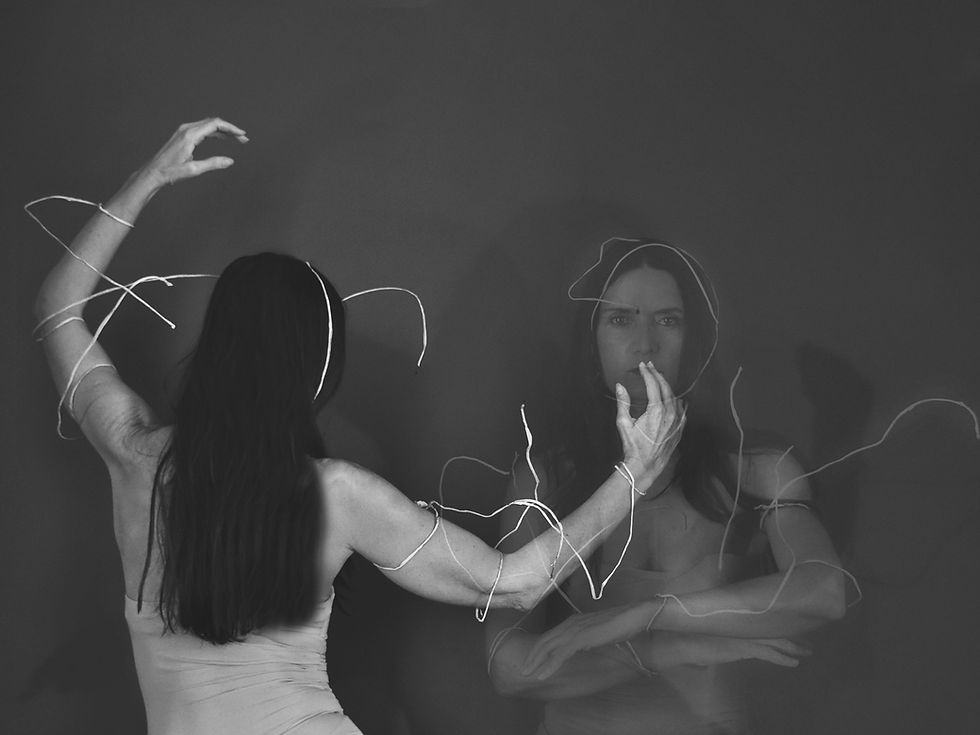
The mirror has never been an innocent object. Long before returning a figure, it had already introduced a fundamental unease: that seeing is not a simple, direct, or transparent act, because every image carries within it a fold, and what appears before our eyes never fully coincides with what is there. In the mirror, the world offers itself and withdraws in the same movement, and this ambivalence makes it so fertile for thinking about the present.
Today, as images proliferate at industrial speed and nearly everything seems to demand a reflection, the mirror is no longer just one thing among others. It has become a logic. We live inside it.

Let us dwell on those images that suspend the automatism of the gaze. Instead of offering the world as immediate evidence, they introduce resistance. At that point, they cease to be mere access and begin to expose the very condition of the visible. Seeing, then, no longer coincides with reaching. Between the eye and what presents itself, there is always a thickness, a medium that filters, returns, and deflects. Visual modernity has grown accustomed to celebrating sharpness as a value, as though clarity were a superior form of truth.
There are, however, appearances that interrupt this fluency. They do not give themselves entirely. They impose delay upon the gaze, along with deviation and friction. And then one realizes that all vision is mediated, that the visible never arrives intact.

Before the mirror, the subject does not find a serene confirmation of self. What appears instead is an intimate exteriority, a figure that belongs to the subject and, at the same time, stands apart from it. The mirror exposes this strange condition according to which the gaze never entirely coincides with itself. There is always a disjunction, a return, a small fracture between presence and recognition. To see oneself is already to experience distance.

Merleau-Ponty grasped this with rare precision when he conceived of the mirror as an event of visibility. He does not reduce the world to a copy. He redoubles the visible, extends it, displaces it, causing the body to discover itself cast outside itself without ever ceasing to be itself. The mirror returns a torsion, not a proof. What I had believed I possessed immediately, my presence, my body, my place in space, reappears in the form of a sensible exteriority.
It brings forth, within presence itself, a minimal distance, enough to undo the fantasy of full coincidence.

The mirror thus moves beyond the field of symbol and enters that of form. It compels us to think the image outside the idea of copying. What appears within it never stabilizes as evidence, because it already emerges traversed by displacement. It always preserves an inaccessible remainder. Art understood this long before any theory of visuality: seeing has never been enough to possess, and the force of a figure often depends on precisely that within it which resists capture. The mirror gathers this question in exemplary fashion, because within it presence never presents itself in a simple state. What offers itself to the gaze already arrives crossed by a minimal difference, and it is this fissure, as small as it is decisive, that brings the mirror close to art: in both, the figure offers itself to the gaze and, at the same time, preserves something that resists apprehension.

That is why the mirror crosses philosophy, literature, and the arts without ever being reduced to one motif among others. What persists in it is a more profound experience: in looking, we discover that we too enter into what can be looked at. We no longer stand before the world as a separate consciousness, but are entangled in the same fabric of the visible. The mirror makes this condition palpable by returning to us a figure that is ours and, at the same time, already escapes us.
It inscribes the body in the field of appearance and undoes the fantasy of a sovereign gaze, external to what it sees. In a time saturated with images, this lesson acquires a different weight. Seeing has never been a solitary gesture. There is always a moment when what we see also reaches us, exposes us. And this is the unease the mirror still preserves: that every presence, at the very instant it offers itself to the gaze, also begins to look back.

Written By Angela Rosana
Learn more about me here
Discover my authorial work here
This project exists thanks to the images generously shared by artists who join my words to create new meanings.
Viva o Clique is always open to new contributions . You can submit your artwork here
Photographer credits are included on the images, with links to their respective Instagram profiles. Get to know more of their work!
If you enjoyed this article, leave your feedback at the end of the page!
Read more articles here
Visit Instagram
Posts will be published on Instagram starting in February 2026.


Comments