


The Insolence of the Imaginary: The Artifices of the Image in Photography and Art
Updated: 15 hours ago

At what point does a cloud begin to resemble something else? We may have spent some time watching it before someone beside us pointed out the shape of an animal. From that moment on, we follow its transformations across the sky with a certain sense of complicity. We recognise a body, make out its legs and even begin to attribute an expression to it. What once belonged to the material world now also belongs to our imaginary. Another person's imagination has become part of the way we see. How much of what we see in the world has its origins in this kind of borrowing?

The British photographer Jake Walters knew how to take advantage of this particular quality of our perception when he was commissioned by The Guardian to photograph the businessman Philip Green. Upset by the way Green had treated him and his assistant, Walters found an opportunity for revenge on the very balcony where the portrait was being taken. All it took was two shrubs, a man and a carefully chosen viewpoint. The newspaper chose not to publish that particular photograph, which Walters himself would share years later, in December 2020. Like someone pointing out a shape in the clouds, Walters suggests something that, once seen, is difficult to unsee.
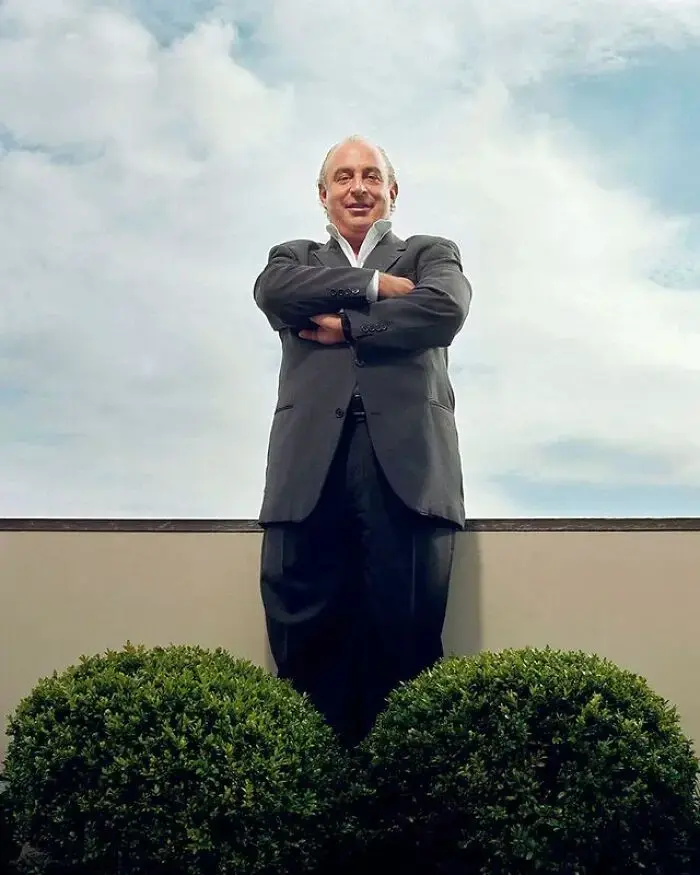
Walters' insult was never actually in front of the camera. What stood before it was a man, two shrubs and the architecture of a balcony. It was in the relationship between these elements that the photographer inscribed his intention. In The Photographic Message (1961), Roland Barthes was already exploring this peculiar quality of photography: its capacity to conceal, beneath the apparent innocence of a record, meanings deliberately conferred upon it. The more natural such an association seems to us, the less aware we become of the gesture of its creator. We look at a photograph with the confidence of someone looking through a window, forgetting that someone else has chosen the vantage point from which we are allowed to see the world.

We accept with surprising ease the portion of the world offered to us on the other side of the frame and, from it, construct an idea of the whole. There is an aspect of Barthes' thinking that allows us to understand the extent of this power: the photographer draws upon a symbolic heritage that is also ours. Through a pose, the presence of certain objects, the aesthetic conventions of an era or even the way light falls upon a body, the photographer can rely on our ability to recognise in these elements something that transcends them. The effectiveness of these devices stems largely from our familiarity with the codes that underlie them. We thus participate in a construction whose authorship we would struggle to determine. After all, who endowed that face with dignity, that body with fragility, that figure with a sense of menace?

There is a peculiar pleasure in recognising the things of the world and discovering them in relationships we had never imagined. The Surrealists made this experience a territory for creation, displacing objects from their familiar contexts and restoring to them possibilities that everyday use had obscured. Photography offered them a particularly intriguing opportunity. The very credibility of the photographic image upon which Barthes would later base his concept of trick effects made it possible to lend verisimilitude to the most delirious inventions of the imaginary. Faced with such images, we are invited to temporarily suspend the rules by which we organise the world. What if the strangeness we experience before certain works of art reveals less about the nature of what we see than about the limits within which we have learned to conceive of reality?

The artist is not always the first to know what they are looking for. As Lee Miller recounts, in 1929, a sudden fright caused her to switch on the light in Man Ray's darkroom in the middle of the developing process. What under other circumstances might have been considered a ruined negative became, for both of them, a subject of exploration. Solarisation would become part of the expressive repertoire of Surrealist photography, in which accidents acquired a certain aesthetic legitimacy. Inherent in this conception of artistic creation was an openness to things that happen independently of our will. Artists themselves could be surprised by their work and discover within it something their own imagination had yet to conceive. And how difficult it is for us, even beyond the realm of art, to accept that beauty may arise from what escapes our control.

We spend much of our lives trying to understand the laws that govern the world and much of the rest imagining ways to transgress them. From a very early age, we learn that bodies fall, that things have certain proportions and that two objects cannot occupy the same place in space at the same time. Yet, as children, we invent worlds in which these laws no longer apply. Art seems to preserve something of this early inclination towards the impossible. Photography, through its ability to interrupt the passage of time, can hold suspended in the air a body that gravity had already claimed. Painting can grant it wings. Part of what fascinates us about these images is the freedom they afford us from the constraints of matter. There is something in this suspension of the laws of the world that restores our capacity to imagine our own existence under different conditions.

Why are we moved by a situation we know has never taken place? The very awareness that we are witnessing a fantasy does nothing to diminish the intensity of our experience. We suffer for characters who never existed, long for places we know only through paintings and recognise, in scenes conceived by someone else's imagination, deeply intimate aspects of our own existence. The freedom with which artists rearrange the elements of the world allows them to give form to feelings for which everyday reality does not always offer a means of expression. And we may find that we recognise ourselves more fully in something someone else has invented than in the images we keep of ourselves.

Let us return for a moment to the cloud we were watching at the beginning. The person who pointed out the shape of an animal might have recognised a different form in it, and our gaze would have followed other paths. I believe that much of what art offers us lies in this possibility of experiencing the world through an imagination other than our own. For a while, we accept the coordinates of a reality invented by someone else, and when we return to our own, something of that experience remains with us. The cloud has long since dissolved into the sky. The animal, however, may remain part of our memory.

Written By Angela Rosana
Learn more about me here
Discover my authorial work here
This project exists thanks to the images generously shared by artists who join my words to create new meanings.
Viva o Clique is always open to new contributions. You can submit your artwork here
Photographer credits are included on the images, with links to their respective Instagram profiles. Get to know more of their work!
If you enjoyed this article, leave your feedback at the end of the page!
Read more articles here
Visit Instagram
Posts will be published on Instagram starting in November 2026.


Comments